
 admin
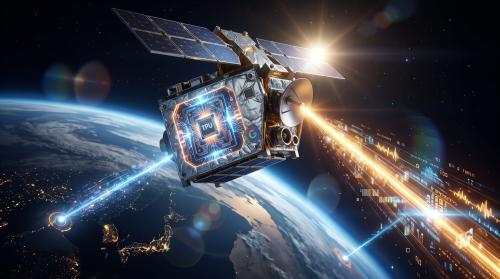
Google's prototype satellite answered a prompt from orbit this week, running its Gemma 4 model on an onboard tensor processing unit and downlinking the result to a ground station in Svalbard, Norway.
The company described the October 30 test as the first AI response from a data-center-class TPU in space. Travis Beals, a senior director in Google Research, called it the mission's "Hello World" milestone.[1]
The prompt was modest: write a haiku about being in space. The model returned three lines, and the team followed up with limericks and prompts that asked the payload to report on its own systems.[1]
Blue marble below
Data streams in silent grace
Starlight feeds my core.
What the test actually proved
The satellite launched on October 1 aboard SpaceX's Transporter-18 rideshare mission and was built with Planet.[1] Since then the team has worked through a commissioning checklist: powering the host and TPU trays, then running early machine learning workloads before attempting the haiku.[1]
The demonstration shows that a radiation-tested TPU can boot, load a model and return output across a single ground pass. It does not show that a satellite can serve real traffic, and Google does not claim otherwise. Its post says the next round of tests will look at thermal stress and radiation exposure in orbit, and that those results feed a 2027 milestone with two interconnected satellites.[1]
Why orbit attracts the compute business
Ground data centers compete for land, grid connections and cooling water. Sunlight in low Earth orbit skips all three constraints, and Google's engineers put the advantage at up to eight times more solar power than the same panel would produce on Earth.[2]
In a sun-synchronous orbit a satellite can stay in near-continuous sunlight, which cuts the battery mass that would otherwise ride on every spacecraft. Google's longer-term plan is a cluster of satellites linked by lasers, sharing one large workload instead of running isolated jobs.[2]
Heat is the hard part
Vacuum removes the easy option. With no air to carry heat away, the only path off the spacecraft is radiation, so the team pairs heat pipes with radiators sized to dump waste heat into empty space.[2] The design has run in a thermal vacuum chamber on the ground, but a chamber cannot fully reproduce orbital conditions.[2]
Radiator area turns directly into launch mass. Benjamin Lee, a computer architect at the University of Pennsylvania, told Scientific American that orbital platforms "need large radiators that can dump heat into the vacuum of space, adding significant mass that has to be launched on rockets."[4]
What survived the ride up
A trip to low Earth orbit lasts about ten minutes and loads the spacecraft at roughly 10 g, with individual chips seeing 50 to 100 g.[2] Google shook the satellite on all three axes to mimic launch frequencies and reported that the hardware held.[2]
Radiation got its own test at the Crocker Nuclear Laboratory at UC Davis, where TPUs ran AI workloads inside a proton beam while engineers watched for bit flips. Google says its Trillium chips absorbed a total ionizing dose larger than a five-year mission would deliver, without permanent failure.[2][3]
The constellation is the actual product
One satellite running a small model is an experiment. The idea in Google's research paper is 81 satellites flying in a cluster about 1 km across and talking over free-space optical links, close enough for high bandwidth and low latency.[3]
Keeping those links alive is a pointing problem before it is a networking problem. Google compares the requirement to hitting a coin-sized target from miles away while both ends move, and plans to test a two-satellite link in 2027.[2]
The cost ledger has not balanced yet
Launch price decides whether any of this works. Google's paper projects launch to low Earth orbit reaching about $200 per kilogram by the mid-2030s, and the company has said the economics only hold if costs keep falling through that decade.[3][4]
Andrew McCalip, an aerospace engineer at Varda Space Industries, modeled the upstream hardware for 1 GW of orbital solar compute at $51.1 billion against $15.9 billion for the same capacity on Earth.[5] Hardware refresh adds more: Lee notes that onboard chips need replacing every five to six years, and each replacement means another launch.[4]
Emissions cut both ways
Solar power in orbit avoids gas turbines, and Starcloud estimates that a solar space data center could produce ten times less carbon than a terrestrial facility running on natural gas.[4] Researchers at Saarland University counted the other side of the ledger, including launch and reentry, and concluded that an orbital data center could emit an order of magnitude more than one on Earth, with reentry pollutants adding to ozone depletion.[4]
A crowded orbital field
Google is not alone up there. Starcloud raised $170 million at a $1.1 billion valuation in March after running Gemini and a small language model on an Nvidia H100 in orbit, and its roadmap targets 5 GW of capacity by 2035.[4][5] SpaceX has applied to launch a constellation of up to a million satellites at 100 kW of compute per tonne.[5]
Axiom Space has tested data center nodes on the International Space Station with backing from the Texas Space Commission, China has begun launching satellites for a Xingshidai constellation, and the EU is studying the idea under a project called ASCEND.[4][5]
What to watch
The useful signals from here are thermal performance under sustained load, the 2027 optical link, and the price of a kilogram to orbit. Radiators sized on paper are the usual failure point, and the link test decides whether close-flying satellites can behave like one machine.[2][3]
For now the milestone is smaller than the headlines suggest: a single TPU tray, one small open model, one poem, sent home from a satellite with months of stress testing ahead of it. Google has not announced a service, a price or a customer for orbital compute, and its own paper treats the launch cost curve as an assumption rather than a result.[1][3]
Sources
- Google Research: We've received our first response from the Project Suncatcher prototype satellite, October 30, 2026.
- Google Research: Behind Project Suncatcher, our moonshot to put AI in space, September 24, 2026.
- Agüera y Arcas et al., Towards a future space-based, highly scalable AI infrastructure system design, arXiv:2511.19468.
- Scientific American: Data Centers in Space Aren't as Wild as They Sound, December 9, 2025.
- Fierce Network: Space data centers, Starcloud, SpaceX and Project Suncatcher explained, March 30, 2026.
Popular Posts



Categories
Tags

Comments