
 admin
admin
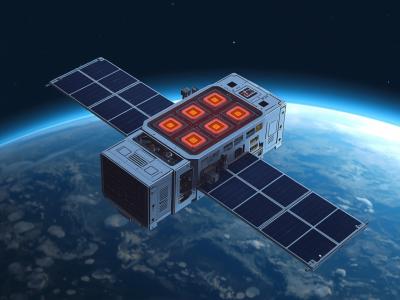
Google's first AI satellite reached orbit on October 1 and almost immediately met the problem its engineers expected to be hardest: heat, not radiation, caps how long its chips can run.
The prototype, built with Planet and launched on SpaceX's Transporter-18 rideshare, carries four of Google's Trillium-generation tensor processing units (TPUs), the same silicon the company runs in its terrestrial data centers. Hours after liftoff, project lead Travis Beals said the team "confirmed contact with the satellite and it is operating as expected."[1]
A refrigerator-sized test bed
The spacecraft, called MVP for minimum viable prototype, lifted off from Vandenberg Space Force Base in California aboard a Falcon 9 that carried 130 payloads to a dawn-dusk sun-synchronous orbit about 650 kilometers up. It draws roughly one kilowatt of solar power, about the draw of a microwave oven, enough for the compute of a single data-center server.[2]
Google is not flying a data center. It is testing whether the components of one can survive years of launch stress, radiation, and thermal swings. Low Earth orbit offers near-constant sunlight and up to eight times more solar power than the ground, the reason the idea exists at all.[4] The mission's value lies in what it rules out, not what it proves.
Beals told Scientific American before launch that the goal was "identifying points of failure," framing the mission as a search for what breaks rather than a demonstration of what works.[3]
Radiation was the worry; heat became the limit
Before launch, Google fired the Trillium chips with a 67 megaelectronvolt proton beam at UC Davis's Crocker Nuclear Laboratory while the chips ran AI workloads. The hardware survived a 15 kilorad total ionizing dose, well above the roughly 750 rad a shielded five-year mission would collect.[2] The company said the chips "hold up remarkably well."[4] The components also endured vibration testing that simulated acceleration loads of up to 100 g.[4]
Heat is the stubborn problem. A vacuum has no air to carry heat away, so a satellite can only radiate it as infrared light from exterior panels. Google routes heat from the chips through heat pipes to those panels, but at full load the chips produce more than the radiators can reject continuously. MVP therefore runs inference on Gemini models in bursts of roughly 15 minutes, then pauses to cool.[2]
Ground tests cannot settle whether that duty cycle holds in orbit. The mission will show whether the radiators keep the chips within their operating range through the roughly 15 swings between sunlight and shadow each day, and whether thermal cycling fatigues the silicon over hundreds of cycles.[2] Surface temperatures on such a satellite swing by more than 100 degrees Celsius between sunlight and shadow, which stresses the radiator design on every pass.[2]
Google's own data flags a second weak point. The high-bandwidth memory that feeds the chips showed irregularities above 2 kilorad, and most radiation-induced bit flips were recoverable by restart, though testing recorded one silent data corruption.[2] Training workloads, which stress memory far more than inference, remain poorly characterized under radiation.
The economics still do not close
Google's peer-reviewed paper in Joule, released alongside the launch, puts the break-even point for orbital compute at launch prices below $200 per kilogram, which the company projects for the mid-2030s.[2][3] That projection assumes roughly 1,800 Starship launches over ten years, and Starship has not yet flown full-reuse orbital missions at anything close to that cadence.[2]
Hardware ages in orbit as well. Solar panels lose about 0.5 to 0.8 percent of their output a year to ultraviolet exposure and space weathering, which steadily narrows the thermal margin and shortens the compute window.[2]
A two-way race with Nvidia
Google is not alone above the atmosphere. Nvidia-backed Starcloud put a single H100 in orbit in November 2025 and plans a follow-up carrying more H100s and an early Blackwell module.[3] SpaceX's Starmind AI1, targeting late 2027, is built around a space-optimized version of Nvidia's Vera Rubin NVL72 rack system at roughly 150 kilowatts per satellite, about 150 times the MVP power budget.[2]
The two approaches differ in strategy, not just hardware. Google bets that qualifying ordinary commercial silicon earns it an upgrade path to every future TPU generation. SpaceX and Starcloud bet that chips designed for space from the start close the viability gap faster.
What the next year decides
MVP should operate for about a year, and can stay in orbit up to six before drag pulls it down.[2] Its readings on thermal cycling and radiation will decide whether orbital AI compute is a research curiosity or the first data point in a real roadmap.
Google's next step is a 2027 mission flying two satellites to test laser links precise enough to connect spacecraft moving at 28,000 kilometers per hour, the change that turns separate chips into something resembling a cluster.[2][3] A full 81-satellite constellation, if it ever flies, sits a decade or more away under the company's own published timelines.[2]
For now, the 15-minute cap stands as the clearest measure of the distance between a promising experiment and a working data center in the sky.
Sources
- Google, Oct 1, 2026: Our Project Suncatcher prototype satellite is in orbit
- Tech Times, Oct 2, 2026: Google Project Suncatcher Reaches Orbit; Cooling, Not Radiation, Now Defines Mission
- temperature2, Oct 3, 2026: Google's orbital TPU satellite phones home and works
- Google, Sep 24, 2026: Behind Project Suncatcher, our moonshot to put AI in space
Popular Posts



Categories
Tags

Comments