
 admin
admin
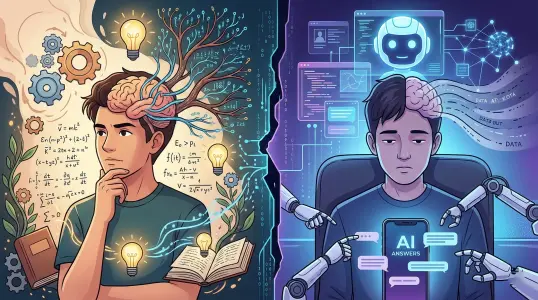
There is a question circulating around dinner tables, office break rooms, and online forums lately that strikes at the heart of our relationship with technology. You might have heard it phrased casually in Indonesian as Ai bikin bodoh? or in English as does AI make us stupid? It is a provocative question, one that taps into a deep-seated fear many of us share as we watch algorithms write our emails, generate our art, and even summarize our meetings. It is natural to wonder if outsourcing our mental heavy lifting to machines might eventually atrophy our own brains. But is this fear grounded in reality, or is it just the latest panic in a long history of technological anxiety?
In this comprehensive guide, we are going to dive deep into the relationship between artificial intelligence and human cognition. We will explore the psychological concepts behind why we feel this way, examine the actual data on how technology affects our brains, and most importantly, discuss how you can harness these powerful tools without losing your edge. Whether you are a student, a professional, or just a curious mind, understanding the dynamics of AI impact on intelligence is crucial for navigating the future. We are not just talking about software; we are talking about the evolution of human thought itself.
The History of Technological Anxiety
To understand the current debate surrounding artificial intelligence dependency, we have to look back. Humans have always been wary of new tools that promise to make life easier. When the written word was invented, Plato famously worried that it would destroy memory. He believed that if people could write things down, they would no longer bother to remember them. Fast forward to the invention of the calculator, and mathematicians feared that students would lose the ability to do basic arithmetic. Then came the internet, and experts warned that our attention spans would vanish and that we would become incapable of deep reading.
Yet, here we are. We still remember things, we still do math, and many of us read more than ever before, albeit in different formats. This historical context is vital because it suggests that the fear that technology and cognition are mutually exclusive is often overstated. Each time a new tool emerges, society goes through a period of adjustment. We panic, we adapt, and eventually, we integrate the tool into our workflow in a way that enhances rather than diminishes our capabilities. The question is not whether AI will change us, because it already is. The real question is whether we will be passive recipients of that change or active architects of it.
When we ask does AI make us stupid, we are often projecting our anxieties about loss of control. It is about the fear that the machine knows better than we do. But history shows us that tools are neutral. It is how we use them that defines the outcome. A hammer can build a house or break a window. Similarly, AI can be a crutch that weakens our mental muscles or a lever that amplifies our intellectual reach. Understanding this distinction is the first step toward mastering the technology rather than letting it master us.
Understanding Cognitive Offloading
To get to the bottom of the AI and human brain relationship, we need to talk about a psychological concept known as cognitive offloading. This is the practice of using physical action or external tools to reduce the cognitive demand of a task. A simple example is using your fingers to count when you are learning addition. Another is writing a grocery list instead of trying to memorize ten items. Cognitive offloading is not inherently bad. In fact, it is a fundamental part of how humans operate efficiently. Our brains have limited working memory, so offloading trivial tasks allows us to focus on complex problem-solving.
The concern with modern AI is that the scope of offloading has expanded dramatically. We are not just offloading memory; we are offloading reasoning, creativity, and synthesis. When you ask a chatbot to write an essay for you, you are offloading the critical thinking process required to structure an argument. When you use an AI tool to debug your code without understanding the error, you are offloading the learning process. This is where the risk of artificial intelligence dependency lies. If we offload too much, we might find ourselves unable to perform these tasks independently when the technology fails or is unavailable.
However, cognitive offloading also frees up mental resources. If AI handles the mundane aspects of data analysis, a researcher can spend more time interpreting the results and forming hypotheses. If a writer uses AI to overcome writer's block, they can focus on refining the narrative voice. The key is intentionality. Are you using AI to bypass thinking, or are you using it to clear the path for deeper thinking? This nuance is often lost in the headline-grabbing debates about smart technology effects. We need to move beyond a binary view of good versus bad and look at the specific contexts in which these tools are applied.
The Case for AI Enhancing Intelligence
Let us flip the script for a moment. Instead of focusing on the risks, let us look at the potential for the future of learning with AI to be incredibly positive. There is a strong argument that AI can actually make us smarter by providing access to personalized education and instant knowledge retrieval. Imagine a tutoring system that adapts to your learning style in real-time, explaining complex concepts until you truly understand them. This is not science fiction; it is happening now. For students who struggle in traditional classroom settings, AI can be the difference between giving up and mastering a subject.
Furthermore, AI can act as a collaborator that challenges our thinking. When you engage with a large language model, you can ask it to play devil's advocate, to critique your arguments, or to provide perspectives you had not considered. This Socratic method of interaction can sharpen critical thinking skills rather than dull them. It forces you to evaluate the output, check for hallucinations, and synthesize the information with your own knowledge. In this scenario, the human is still the pilot, and the AI is the co-pilot. The intelligence comes from the collaboration, not just the machine.
There is also the aspect of accessibility. AI tools can translate languages instantly, summarize dense technical papers, and convert text to speech for those with visual impairments. These capabilities democratize information. When information is more accessible, more people can learn and contribute to the global knowledge pool. This suggests that the net effect of AI on human intelligence could be positive, raising the baseline of what people are capable of achieving. The barrier to entry for complex tasks is lowering, which means more innovators can enter the field. The focus shifts from rote memorization to application and creativity, which are higher-order cognitive skills.
The Risks of Passive Consumption
Despite the benefits, we cannot ignore the dangers. The primary risk is not the technology itself, but passive consumption. If you accept every output from an AI as truth without verification, you are training your brain to be uncritical. This erosion of critical thinking skills is a genuine concern. In an era where deepfakes and generated content are ubiquitous, the ability to discern truth from fabrication is more important than ever. If we rely on AI to tell us what is true, we lose the ability to investigate for ourselves.
Another risk is the homogenization of thought. AI models are trained on existing data, which means they tend to produce average, statistically likely outputs. If everyone uses the same tools to write emails, create art, or solve problems, we might see a decline in unique human creativity. We risk entering an echo chamber where ideas are recycled and refined but never truly new. This is a subtle form of intellectual stagnation. It is not that we become stupid in the sense of losing IQ points, but rather that we become less original and less willing to take cognitive risks.
There is also the issue of skill decay. Just as using GPS exclusively can impair your natural sense of direction, using AI for all writing tasks can impair your ability to structure sentences and articulate thoughts clearly. If you do not practice a skill, you lose it. This is basic neuroplasticity. The brain prunes connections that are not used. Therefore, if we completely delegate core competencies to algorithms, those neural pathways may weaken over time. This is why maintaining a balance is essential for long-term cognitive health.
Common Challenges and How to Overcome Them
Navigating the landscape of AI ethics and intelligence comes with hurdles. Many people find themselves stuck between the efficiency of AI and the desire to maintain their own skills. Here are some common challenges users face and practical ways to handle them.
Challenge 1: The Temptation to Cheat
It is incredibly tempting to let AI do the work, especially when you are under pressure. Students might use it to write essays, and employees might use it to generate reports without review.
Solution: Set strict personal boundaries. Decide beforehand which parts of a task you will do manually. For example, use AI to generate an outline, but write the content yourself. Treat AI as a brainstorming partner, not a ghostwriter.
Challenge 2: Verification Fatigue
Checking AI output for accuracy can sometimes take as long as doing the work yourself, leading to frustration.
Solution: Develop a verification checklist. Focus on checking claims, data points, and logic flows rather than every single word. Over time, you will get better at spotting typical AI errors, which speeds up the process.
Challenge 3: Loss of Confidence
Some people feel intimidated by AI, feeling that their own contributions are inferior compared to the speed and polish of machine output.
Solution: Remember that AI lacks human experience and empathy. Your unique perspective is valuable. Use AI to handle the drudgery so you can focus on the high-value human elements like strategy, empathy, and nuanced judgment.
Challenge 4: Over-Reliance on Automation
Automating too many workflows can leave you vulnerable if the tool changes or fails.
Solution: Periodically perform tasks manually to keep your skills sharp. Think of it like exercise. You do not lift weights to move furniture; you lift weights to stay strong. Keep your mental muscles active.
By acknowledging these challenges, you can proactively design your workflow to mitigate them. It is about building a sustainable relationship with technology where you remain in the driver's seat.
Best Practices for Healthy AI Interaction
So, how do we ensure that we are using these tools to enhance our intelligence rather than diminish it? It starts with active engagement. Instead of copying and pasting a prompt and accepting the first result, engage in a dialogue. Ask the AI to explain its reasoning. Ask it for alternative viewpoints. This turns the interaction into a learning opportunity. You are not just getting an answer; you are exploring the logic behind it.
Another best practice is to use AI for iteration rather than creation. Let the machine generate the first draft, the rough sketch, or the initial code structure. Then, apply your human expertise to refine, critique, and improve it. This ensures that the final output bears your intellectual fingerprint. It also ensures that you understand the material thoroughly. If you cannot improve upon the AI's work, you might not understand the subject matter well enough, which is a signal to study more.
Here is an example of how you might structure a prompt to ensure active learning rather than passive consumption:
# Instead of asking for a direct answer, ask for a guide
prompt = """
I am trying to understand the concept of neural networks.
Please do not just explain it to me.
Instead, ask me questions that will help me derive the understanding myself.
Correct me only if I am fundamentally wrong.
"""
# This approach forces the human brain to work, using AI as a tutor.
This kind of prompt engineering shifts the dynamic. You are using the tool to stimulate your brain, not replace it. Additionally, diversify your tools. Do not rely on a single model. Different models have different strengths and weaknesses. Comparing outputs can help you develop a critical eye. Finally, schedule tech-free zones. Ensure there are times in your day where you think, write, and create without any digital assistance. This preserves your independent cognitive abilities.
The Future of Human-AI Collaboration
Looking ahead, the relationship between humans and machines will likely become even more integrated. We are moving toward a symbiotic relationship where the distinction between human intelligence and artificial intelligence blurs. The goal is not to compete with AI but to collaborate with it. The most successful individuals in the future will not be those who can out-calculate the machine, but those who can ask the best questions, interpret the results, and apply them ethically.
This shift requires a change in how we view education and professional development. We need to focus less on memorization and more on adaptability, emotional intelligence, and complex problem-solving. These are areas where humans still vastly outperform machines. By leaning into our human strengths, we can ensure that AI serves as a complement to our intelligence. The narrative does not have to be about replacement; it can be about augmentation.
We must also consider the societal implications. As AI becomes more prevalent, we need to ensure equitable access so that the benefits of augmented intelligence are shared broadly. We need policies that protect against misuse while encouraging innovation. The conversation about AI ethics and intelligence is ongoing, and everyone has a role to play in shaping it. Your choices today about how you use technology contribute to the broader culture of tomorrow.
Conclusion
So, does AI make us stupid? The answer is not a simple yes or no. It depends entirely on how you choose to interact with it. If you use AI as a crutch to avoid thinking, then yes, it can lead to cognitive decline. But if you use it as a tool to amplify your curiosity, verify your knowledge, and handle mundane tasks, it can free you to reach higher levels of creativity and understanding. The technology itself is neutral; the outcome is determined by human intent.
We are standing at a crossroads in the history of cognition. We have the opportunity to offload the tedious parts of thinking so we can focus on what makes us truly human. But this requires vigilance. We must remain critical, stay curious, and never stop learning. Do not let the convenience of automation lull you into complacency. Keep your mind active, challenge the outputs you receive, and remember that you are the master of the tool, not the other way around.
Take action today. Audit your current use of AI tools. Are you using them to learn or to bypass learning? Make a commitment to use technology intentionally. Share this article with your friends and colleagues to spark a conversation about healthy tech habits. Together, we can ensure that the future of intelligence is brighter, sharper, and distinctly human.
Popular Posts




Categories
Tags

Comments