
 zakialawi
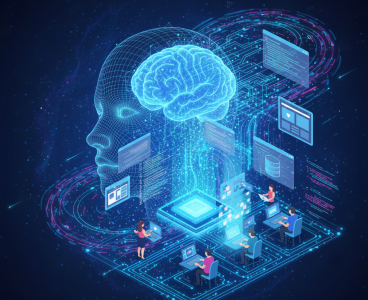
AI Powered Web Development Revolutionizing the Future
The landscape of web development is undergoing a profound transformation, all thanks to the increasing integration of artificial intelligence. What was once considered a futuristic concept is now rapidly becoming a tangible reality, with AI web development poised to revolutionize how we design, build, and maintain websites and web applications. This isn't just about minor tweaks; it's about a fundamental shift that promises to enhance productivity, democratize creation, and open up entirely new possibilities for digital experiences. Understanding this evolution isn't just an advantage; it's a necessity for anyone looking to stay relevant and thrive in the fast-paced tech world.
What is AI Assistance in Web Development?
At its core, AI assistance in web development refers to the use of artificial intelligence technologies to aid developers throughout various stages of the development lifecycle. This can range from intelligent code autocompletion and error detection to automated UI/UX design, performance optimization, and even comprehensive content generation. It's about empowering developers with smart tools that can perform repetitive tasks, offer predictive insights, and even generate complex code or designs, thereby allowing human developers to focus on higher-level problem-solving and creative endeavors. Think of AI as a highly efficient, tireless co-pilot, not a replacement.
Key Areas Where AI is Making an Impact
Code Generation and Autocompletion
One of the most immediate and impactful applications of AI is in assisting with code writing. Tools leveraging large language models (LLMs) can suggest entire blocks of code, complete functions, or even translate natural language descriptions into functional code snippets. This significantly speeds up the coding process and reduces the likelihood of syntax errors. For example, an AI assistant might suggest JavaScript for a common UI interaction:
// Developer types: "function to fetch user data"
// AI might suggest:
async function fetchUserData(userId) {
  try {
    const response = await fetch(`/api/users/${userId}`);
    if (!response.ok) {
      throw new Error(`HTTP error! status: ${response.status}`);
    }
    const data = await response.json();
    return data;
  } catch (error) {
    console.error("Error fetching user data:", error);
    return null;
  }
}
This capability accelerates development by automating boilerplate code and complex logic patterns.
UI/UX Design and Prototyping
AI is increasingly making strides in the design phase. Tools can analyze user behavior data to suggest optimal layouts, color schemes, and interactive elements. They can generate multiple design variations from a simple text prompt or even convert wireframes into high-fidelity prototypes. This not only democratizes design by making it accessible to non-designers but also significantly reduces the time from concept to implementation, leading to more user-centric and visually appealing interfaces.
Automated Testing and Debugging
Finding bugs and ensuring code quality has always been a time-consuming part of web development. AI-powered testing tools can automatically generate test cases, identify potential vulnerabilities, and even predict where bugs might occur based on code patterns. This leads to more robust applications with fewer errors, improving the overall quality and reliability of web solutions. AI can analyze vast amounts of code and execution paths far faster than any human, pinpointing issues with impressive accuracy.
Performance Optimization and Security
AI algorithms can analyze web application performance metrics, identifying bottlenecks and suggesting optimizations for code, database queries, and server configurations. Similarly, AI-driven security tools can continuously monitor applications for anomalies, detect malicious patterns, and help developers patch vulnerabilities proactively, making websites safer and faster for users. This proactive approach is crucial in an era where speed and security are paramount.
Low-Code/No-Code Platforms Enhanced by AI
The rise of low-code and no-code platforms has already lowered the barrier to entry for web development. When infused with AI, these platforms become even more powerful, allowing users to build sophisticated applications with minimal or no manual coding. AI can interpret user requirements in natural language and automatically generate components, workflows, and even entire applications, empowering citizen developers and significantly accelerating enterprise development.
Benefits for Developers and Businesses
The adoption of AI assistance tools brings a wealth of advantages. For developers, it translates to increased efficiency, freeing them from repetitive tasks and allowing them to focus on innovative problem-solving. This fosters greater job satisfaction and opens doors for learning new skills. For businesses, the benefits include faster time-to-market for new products, reduced development costs, and the ability to build more complex and personalized experiences for their users. The synergy between human creativity and AI efficiency is leading to unprecedented levels of productivity and innovation in the digital realm.
Common Challenges and How to Overcome Them
While the promise of AI development trends is immense, navigating its integration comes with its own set of hurdles.
Over-reliance and Skill Decay
Challenge: Developers might become overly dependent on AI tools, potentially leading to a decline in fundamental coding skills or an inability to debug complex issues that AI might not fully grasp. How to Overcome: Treat AI as a powerful assistant, not a crutch. Continuously engage in learning core concepts, review AI-generated code critically, and understand the "why" behind its suggestions. Use AI to learn faster, not to avoid learning.
Data Privacy and Security Concerns
Challenge: Many AI coding assistants send code snippets or project data to external servers for processing, raising concerns about intellectual property and data breaches. How to Overcome: Choose AI tools that prioritize privacy and security, offering on-premise or secure cloud processing options. Understand the terms of service for any AI tool you use regarding data handling. Be cautious with sensitive information.
Ethical Considerations and Bias
Challenge: AI models are trained on existing data, which can sometimes contain biases that might inadvertently be perpetuated in generated code or design suggestions, potentially leading to exclusionary or unfair user experiences. How to Overcome: Human oversight is critical. Developers must act as ethical gatekeepers, reviewing AI outputs for fairness, accessibility, and inclusivity. Diversify training data for AI models and promote transparency in their development.
Integration Complexity
Challenge: Integrating new AI tools into existing development workflows and tech stacks can be complex and time-consuming, requiring adjustments to pipelines and team practices. How to Overcome: Adopt AI tools incrementally. Start with pilot projects to understand their efficacy and integration requirements. Prioritize tools that offer good API support and integrate seamlessly with popular IDEs and version control systems.
Keeping Up with Rapid Change
Challenge: The field of AI is evolving at an incredible pace, with new tools and techniques emerging constantly, making it hard for developers to stay updated. How to Overcome: Embrace continuous learning. Follow AI research, participate in developer communities, and experiment with new tools regularly. Focus on understanding core AI concepts rather than just specific tool features.
The Future Landscape with AI
The future web dev landscape will undoubtedly be characterized by an even deeper integration of AI. We can anticipate more sophisticated code generation AI that understands context better, AI-powered systems that can predict user needs before they're explicitly stated, and perhaps even fully autonomous development environments for specific tasks. This shift will redefine the role of the web developer, moving them towards more architectural, strategic, and creative responsibilities, while AI handles much of the heavy lifting and repetitive coding. It promises a future where web creation is faster, more efficient, and accessible to a broader range of innovators.
Conclusion
The synergy between human developers and artificial intelligence is not just a trend; it's the inevitable evolution of web development. By embracing AI web development, we are unlocking new frontiers of creativity, efficiency, and possibility. The future holds exciting prospects where AI acts as an invaluable partner, enhancing our capabilities and allowing us to build more intelligent, user-friendly, and robust web experiences than ever before. Don't be left behind in this digital revolution.
Start your journey today by trying one of these AI-powered tips and share your experiences in the comments section below!
Popular Posts




Categories
Tags

Comments