
 admin
admin
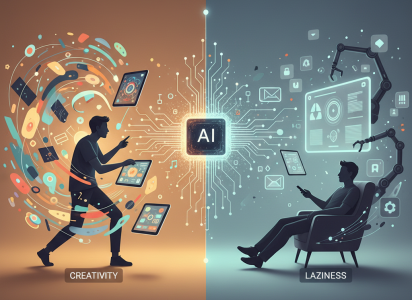
Welcome to the fascinating discussion about artificial intelligence and its profound influence on human capabilities. The rise of AI has sparked a crucial debate: does this powerful technology make us more creative, or does it risk pushing us towards intellectual laziness? It's a question that delves into the very core of what it means to be human in an increasingly automated world. Understanding the multifaceted AI impact on our daily lives, particularly on our creative processes and work habits, is essential for navigating the future successfully. This article will explore both sides of the coin, offering insights into how AI can amplify our imaginative potential while also highlighting the pitfalls we must learn to avoid.
AI as a Catalyst for Human Creativity
Many believe that artificial intelligence is an unparalleled tool for enhancing human creativity. Far from replacing our imaginative spark, AI can act as a powerful co-creator, muse, and assistant. Think about brainstorming sessions: instead of staring at a blank page, AI can instantly generate a multitude of ideas, perspectives, and starting points. This isn't about AI doing the thinking for us, but rather about it expanding the initial pool of possibilities, allowing our human minds to then connect, refine, and innovate.
Brainstorming and Idea Generation with AI
AI-powered tools can quickly analyze vast datasets, identify trends, and even predict potential outcomes, offering insights that might take humans weeks or months to uncover. For writers, artists, designers, and marketers, this means overcoming creative blocks becomes easier. Imagine you're writing a story and need a plot twist, or a designer looking for fresh color palettes. An AI can offer hundreds of suggestions, freeing you from mundane idea generation and letting you focus on the artistic execution and emotional depth that only a human can truly provide.
For example, a marketing team struggling to come up with new campaign slogans could use an AI to generate a diverse list of options based on their product and target audience. The human team then filters, combines, and refines these suggestions, adding the nuance, humor, or emotional resonance that makes a slogan truly impactful. This collaboration leverages AI's speed and breadth with human intuition and strategic thinking.
Automating the Mundane to Free Up Creative Time
One of the most significant ways AI boosts creativity is by automating repetitive, time-consuming tasks. Developers no longer need to write boilerplate code, designers can automate tedious image resizing, and content creators can quickly transcribe audio or generate initial drafts. This liberation from drudgery means more time and mental energy can be dedicated to higher-level strategic thinking, problem-solving, and truly innovative work. When you're not bogged down by administrative tasks, your mind is free to wander, explore, and make unexpected connections – the very essence of the creative process.
Consider a graphic designer. Instead of spending hours meticulously removing backgrounds from dozens of images, an AI tool can do it in seconds. This allows the designer to spend that saved time on developing innovative layouts, experimenting with new visual styles, or engaging directly with clients to understand their vision more deeply.
The Risk of Cognitive Laziness
While the benefits are clear, it's equally important to address the potential downsides. The concern that AI could foster cognitive laziness is a valid one. If AI can solve complex problems, generate content, and even make decisions for us, what happens to our critical thinking skills? There's a risk that over-reliance on AI might lead to a decline in our ability to perform these tasks independently, much like a calculator diminishes our mental math skills if we stop practicing.
Declining Critical Thinking and Problem-Solving Skills
If we always ask an AI for the "answer" without first attempting to grapple with the problem ourselves, we might bypass the mental exercise that builds intellectual muscle. The joy and growth that come from struggling with a difficult problem and finally finding a solution could be lost. For students, relying too heavily on AI for essay writing or problem-solving without understanding the underlying concepts could lead to superficial learning and a lack of true comprehension.
This isn't to say AI is inherently bad, but rather that its use requires discipline. Just as a GPS is invaluable for navigation but doesn't teach us to read a map, AI provides solutions but doesn't inherently teach us the problem-solving journey. The key is to use AI as a guide and a tool, not as a replacement for our own cognitive effort.
The "Black Box" Problem and Loss of Agency
Another concern is the "black box" nature of some AI systems. We might accept an AI-generated solution without understanding how it arrived at that conclusion. This lack of transparency can lead to a loss of agency and an inability to critically evaluate the quality or biases of the AI's output. If we become comfortable with simply accepting what the AI provides, our capacity for independent thought and judgment can erode.
Maintaining a healthy skepticism and a commitment to understanding the foundations of AI-generated content or solutions is crucial. We must always remember that AI models are trained on existing data, which can contain biases, and their outputs are only as good as their inputs and algorithms.
Common Challenges and How to Overcome Them
Navigating the AI landscape presents several challenges, but with awareness and strategic approaches, we can overcome them to ensure AI remains a net positive for human development.
1. Over-Reliance and Skill Atrophy
Challenge: The temptation to let AI do all the heavy lifting, leading to a decline in our own skills. For instance, always using AI to summarize articles might diminish our own summarization and critical reading abilities.
How to Overcome:
- Use AI as a sparring partner: Before asking AI for a solution, try to solve the problem yourself. Then, compare your solution with AI's. Analyze the differences and learn from them.
- Focus on higher-order tasks: Delegate repetitive tasks to AI, but reserve your mental energy for conceptualization, strategic planning, ethical considerations, and nuanced decision-making.
- Regularly "unplug": Dedicate time to creative pursuits or problem-solving without any AI assistance to keep your skills sharp.
2. Maintaining Originality and Authenticity
Challenge: If everyone uses the same AI models, will all content start to sound the same? Will our unique voice and perspective get lost?
How to Overcome:
- Infuse personal experience: Always combine AI-generated content with your unique insights, personal anecdotes, and specific expertise. AI can provide a framework; you provide the soul.
- Refine and personalize: Treat AI output as a draft or a starting point, not a final product. Heavily edit, rewrite, and adapt it to your own style and specific context.
- Use AI for inspiration, not duplication: Employ AI for diverse idea generation, exploring unfamiliar concepts, or finding new ways to express an existing idea, rather than simply reproducing its output.
3. Ethical Concerns and Bias
Challenge: AI models can perpetuate and amplify biases present in their training data, leading to unfair or incorrect outputs. Relying on such outputs without critical evaluation can have serious consequences.
How to Overcome:
- Verify and cross-reference: Always fact-check AI-generated information, especially for critical data or sensitive topics. Use multiple sources and your own judgment.
- Understand AI limitations: Be aware that AI lacks true understanding, empathy, or moral judgment. Its outputs are statistical predictions, not necessarily truth or wisdom.
- Advocate for responsible AI development: Support initiatives that promote transparency, fairness, and accountability in AI algorithms.
Leveraging AI for Enhanced Creative Potential
The key lies in understanding AI not as a competitor or a crutch, but as an advanced tool within your creative arsenal. It's about human-AI collaboration, where each brings its unique strengths to the table.
Practical Tips for Smart AI Integration:
- Define Your Role: Be the director, the editor, the visionary. Let AI be your assistant, providing the raw materials or executing your commands.
- Ask Better Questions: The quality of AI output is directly proportional to the quality of your input. Learn to craft clear, specific, and insightful prompts.
- Experiment and Explore: Use AI to venture into creative territories you might not have considered before. It can rapidly prototype ideas, generate variations, and simulate scenarios.
- Learn Continually: Stay updated on AI advancements. The tools are evolving rapidly, and understanding new capabilities will allow you to integrate them more effectively.
Consider this simple prompt example to kickstart a creative writing project, demonstrating how AI can provide a diverse starting point:
Prompt: "Generate five unique opening lines for a science fiction short story about a forgotten space colony on a distant, arid planet, where the colonists have developed a peculiar new tradition."An AI might respond with various options, each offering a different tone or angle, from which a human writer can select, modify, and build their narrative.
The Future of Human Potential with AI
Ultimately, the question of whether AI makes us more creative or lazy depends entirely on how we choose to use it. If approached mindfully, AI can be a powerful accelerator for human potential. It can automate the mundane, provide fresh perspectives, and expand our cognitive bandwidth, allowing us to dedicate more energy to truly innovative and human-centric endeavors.
The goal is not to outsource our thinking, but to augment it. It's about building a symbiotic relationship where AI handles computation and data analysis, while humans provide intuition, empathy, critical judgment, ethical considerations, and the unique spark of originality that defines our species. By embracing AI as a partner rather than a master or a substitute, we can unlock unprecedented levels of innovation and truly redefine the boundaries of human achievement.
The debate isn't about AI's inherent nature, but about our own choices. Will we leverage these powerful AI tools to elevate our creative thinking, cultivate new skills, and solve complex global challenges, or will we succumb to the temptation of effortless output? The answer lies in our hands, in how we educate ourselves, adapt our workflows, and continuously strive for intellectual engagement.
So, what are your thoughts? How do you personally leverage AI to boost your creativity while avoiding the trap of laziness? Share your own tips and experiences in the comments section below! Let's build a community of conscious AI users who harness its power for positive impact.
Popular Posts



Tags

Comments